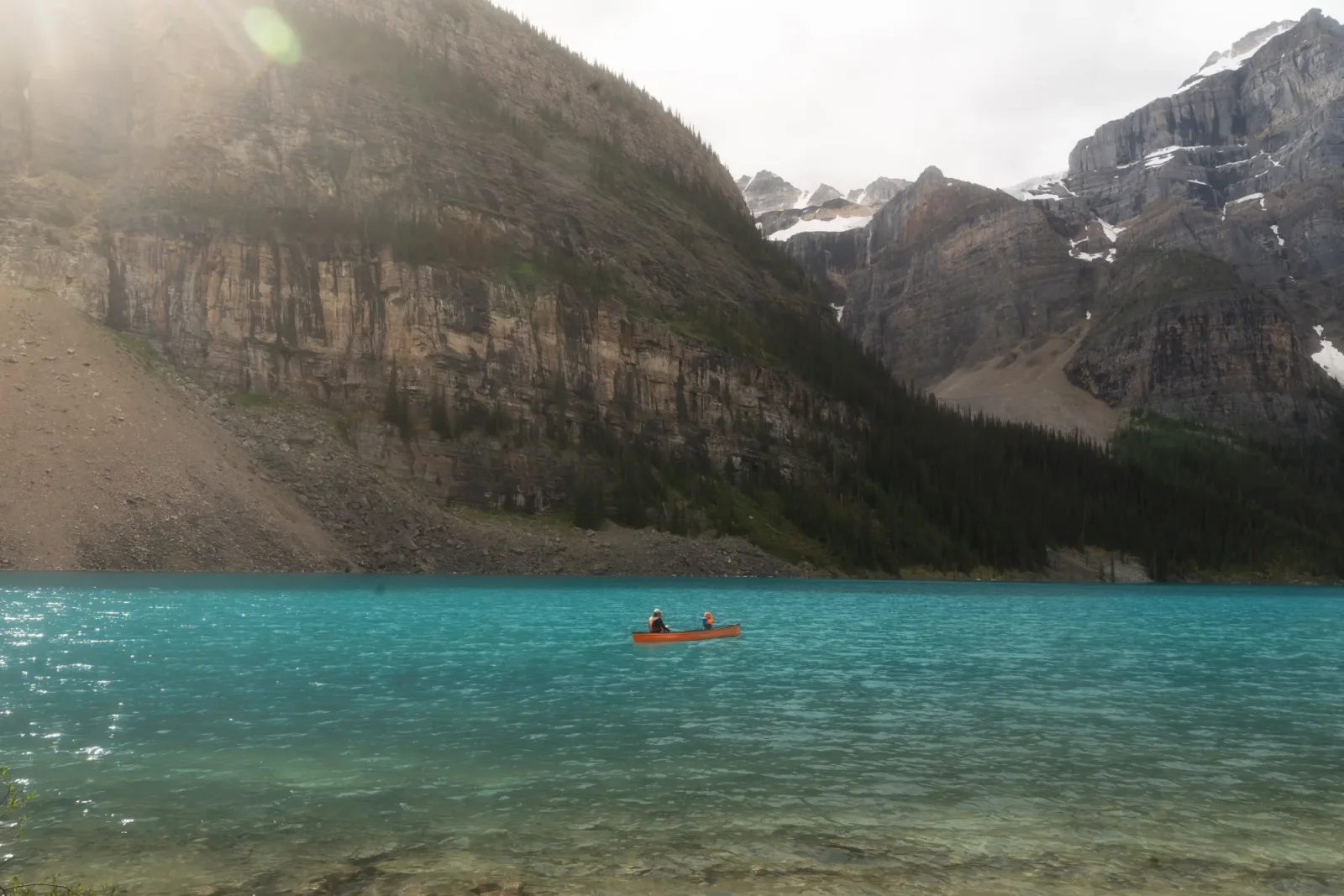
Mountain weather can change the day beyond town.Photo: Cody Gray
Updated September 8, 2026By the Banff.tips editorial teamWritten for real visits. Double-check anything time-sensitive before you go.
Check before going
Forecasts, trail conditions, notices, closures, access, and avalanche information can change quickly. Use the live official pages before leaving; this guide does not replace route-specific checks.
Bottom line
Read the forecast, then read the route.
Town weather helps shape the day. Official mountain-area and route-specific checks decide whether the original plan still fits.
Simplest planIf the answers are uncertain, choose a closer, lower-commitment backup.
01
Read this first
A Banff town forecast answers a town question
A Banff town forecast is useful for planning time outdoors in town. It is not a forecast for every trail, lake, pass, or mountain destination.
Use the town forecast to shape your day, then check the wider mountain picture and the route you actually plan to use before you leave.
If the route-specific answers are uncertain, choose a lower-commitment nearby plan instead of treating the forecast as a green light.
A town forecast starts the plan. It does not clear the route.
Details can change quickly — check before going.
Park admission/pass status: Check current park admission requirements separately from your weather and trail checks.
Location parking fees: Check destination-specific parking fees and access details before leaving.
Transit/shuttle reservations: Confirm any transit or shuttle booking, departure, and return requirements before choosing your route.
Parks Canada says weather can differ considerably between relatively nearby places and can change through the day.
Temperature generally falls about 1°C for every 200 m of elevation gain. Treat that as a reason to pack and check, not a formula for predicting a summit.
A warm trailhead, clear road, or good-looking webcam does not confirm the weather, snow, wind, visibility, or route finding at your destination.
Read the mountain picture before the destination
Start with Environment Canada for Banff town, then compare the Southern Alberta and Mountain Park forecast when the day reaches beyond town.
That bulletin uses named locations and reference elevations. It is useful context for a mountain day, but it is still not a route-specific conditions report.
Do not calculate a destination forecast from elevation. Current trail conditions, notices, closures, and access information answer different questions.
Five checks before an outdoor day
Check the Banff town forecast for the start and end of your day.
Check the Southern Alberta and Mountain Park forecast for the wider area when your plan leaves town.
Check Parks Canada trail conditions for the route you selected.
Check current Parks Canada warnings, closures, and route-specific access information.
If the route and season make avalanche terrain relevant, check the official Avalanche Canada bulletin as well. Do not use this guide to rate terrain or summarize current avalanche conditions.
When the original plan no longer fits
Do not force a view-first attraction or an exposed objective through poor visibility, uncertain conditions, or access friction.
Downshift to a closer town, cultural, food, or lower-commitment plan that still works with the information you have, then make its own current checks.
The point is not to predict the perfect mountain day. It is to choose a day that still makes sense when the weather is more complicated than the town forecast.
03
Avoid false certainty
Three weather-reading mistakes that make a day fragile
These come up over and over in visitor questions. None of them are dramatic — just easy to dodge if you read them first.
✗
Treating sunshine in town as a route report.
Town, trailhead, lake, pass, and destination can have different weather and surface conditions.
✗
Turning elevation into a forecast calculator.
A general temperature relationship cannot confirm the conditions, access, or hazards on a particular route.
✗
Checking yesterday's report instead of today's route.
Weather, closures, trail surface, and access can change. Open the live official pages before you commit.
04
Before leaving
Five checks that keep the decision tied to the actual route
0 of 5 checked
Questions we get asked
Frequently asked
Can I use Banff's forecast for Lake Louise or a mountain pass?
Use it for a broad starting picture only. Compare the official mountain-area forecast and current route conditions for the place you actually plan to visit.
Should I subtract degrees to make my own summit forecast?
No. The elevation relationship explains why a town forecast can differ from a mountain day, but it cannot predict route conditions, visibility, snow, wind, closures, or avalanche exposure.
What should I do when the forecast is uncertain?
Choose a lower-commitment nearby plan or rebuild the day around town, then check the current information for that alternative before going.